Date/Time
Date(s) - 06/23/2026 - 06/24/2026
10:00 am - 12:00 pm
Location
Maryland Live! Casino and Hotel
Categories No Categories
We have an exciting program planned for our Summer Conference on June 23rd- June 24th at Maryland Live! Casino and Hotel.
The Maryland DC Chapter of APPA (MD/DC APPA) is pleased to announce our upcoming two-day Summer Forum with six sessions focused on critical and emerging topics in facilities management across higher education. We have a collection of dynamic professionals who will share case studies, insights, and practical strategies that inform, inspire, and advance our collective knowledge.
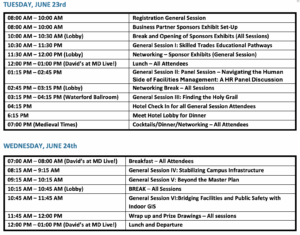
Session I: Skilled Trades Educational Pathways (Tuesday, 6/23, 10:30-11:30)
Higher education facilities departments face growing workforce pressures as skilled trades teams age, retirements increase, and recruitment pipelines fail to keep pace. This session shares how Towson University addressed these challenges through the Skilled Trades Education Pathway (STEP), an internal, work-based training model that builds talent from within and strengthens long-term recruitment.
Using STEP as a case example, participants will examine key workforce issues, including shrinking applicant pools, private-sector competition, limited awareness of trades careers, and widening skills gaps. The session will outline how Towson developed a paid rotational program for high school seniors by leveraging campus trade shops, staff expertise, and school partnerships. Attendees will also learn how workforce analysis helped define roles, identify skill gaps, support succession planning, and guide training priorities. Participants will leave with practical strategies for developing scalable, cost-effective training pathways that improve recruitment, workforce readiness, and operational stability.
Presenter: Michelle Joyce, Workforce Development Coordinator, Towson University
Michelle Joyce is the Workforce Development Coordinator in the Campus Operations Division at Towson University, where she leads the Skilled Trades Education Pathway (STEP) Program. Michelle is passionate about removing barriers to access for underrepresented populations by expanding hands-on training, mentorship, and career exposure within higher education facilities’ operations. Michelle has presented on workforce development and facilities-based training models at regional conferences, including the ERAPPA Conference in Atlantic City in fall 2025. Her work focuses on aligning operational needs with inclusive talent pipelines, positioning universities as anchor institutions that strengthen both internal workforce capacity and the surrounding community.

Session II: Panel Session – Navigating the Human Side of Facilities Management: A HR Panel Discussion (Tuesday, June 23rd, 1:15-2:45)
Managing a facilities workforce is one of the most complex challenges in K12 and higher education — and it’s one that doesn’t always get the attention it deserves. From skilled trades recruitment to union relations, workforce development to succession planning, HR professionals in facilities management operate at the intersection of people, operations, and institutional mission.
Join us for a dynamic panel discussion featuring HR and facilities management leaders from across the university sector as they tackle the pressing workforce issues shaping the field today. Panelists will share real-world strategies, hard-won lessons, and fresh perspectives on topics including skilled trades recruitment, DEI in a historically homogeneous industry, performance management in a unionized environment, and preparing the facilities workforce for a technology-driven future.
Whether you’re an HR professional, a facilities director, or an institutional leader looking to strengthen your workforce strategy, this conversation will offer actionable insights you can bring back to your campus/school system.
Session III: Finding the Holy Grail: The Integration of Capital and Maintenance Datasets (Tuesday, 6/23rd, 3:15-4:15)
One of the most common issues that we hear from our clients today is a desire to integrate their capital and maintenance planning processes. If it were easy, everyone would be doing it. This session explores how institutions can better align capital planning with operations and maintenance (O&M) to improve decision-making, reduce costs, and maximize asset value. Rather than treating capital renewal and maintenance as separate silos, this session will highlight the benefits of an integrated approach—supported by real-world examples and practical insights from the field. Attendees will leave with actionable strategies to take the next steps on their asset management journey.
Presenter: Bill Roth, President & CEO, Roth IAMS
Bill Roth, President and CEO of Roth IAMS and Co-Founder of SLAM Technologies, is a leader in Integrated Asset Management with more than 30 years of experience serving public and private sector clients across North America. Having assessed millions of square feet, he brings deep expertise in facility and infrastructure asset management, with a strong focus on consistent, defensible data and its role in effective decision-making. Bill is committed to addressing the Deferred Renewal and Capital Maintenance backlog and has made that mission central to Roth IAMS. An active member of organizations including APPA, ERAPPA, SRAPPA, and RMA, he is a frequent speaker, writer, and webinar host on the evolving asset management landscape.

Session IV: Stabilizing Campus Infrastructure: A Refurbishment-First Alternative to Asset Replacement (Wednesday, 6/24, 8:15- 9:15)
Deferred maintenance is growing faster than available capital in higher education, leading to more asset failures, outages, and operational disruption. Yet full replacement is often too expensive and too slow to stabilize campus infrastructure at scale. This session focuses on what comes after the facility condition assessment: how institutions can move from insight to action in a capital-constrained environment. Participants will explore a refurbishment-led model that renews key asset components to extend useful life, improve performance, and reduce failures at far lower cost than full replacement. Through real-world examples from higher education and healthcare, the session will show how to evaluate components, assess risk and performance, and right-size scopes of work to match institutional priorities. Attendees will leave with a practical framework for stabilizing infrastructure, reducing deferred maintenance backlogs, and shifting from reactive replacement to proactive renewal.
Presenters: Erica Barbuto and John Less at The Halcyon Facilities Group
Erica is a partner at The Halcyon Facilities Group and has spent her career guiding >60 higher education and healthcare clients on deferred maintenance strategies, capital planning and space utilization efforts. Erica’s industry knowledge and collaborative approach to tackle facility challenges has helped clients increase capital budgets and daily operating resources. Previous speaking engagements include The Higher Education Facilities Forum, The Association of Physical Plant Administrators, The Chronicle of Higher Education and The National Association of State Facilities Administrators. She holds a BA from Gettysburg College. John is a partner at The Halcyon Facilities Group providing FM solutions to clients across healthcare and higher education. John’s other work experience includes Regional Director of Operations for Crothall Healthcare & held facility leadership roles at Virginia Commonwealth University, the NIH, & the US Navy. John led FM work forces >400 staff and operating budgets of >$100M. He is a registered Professional Engineer, received his MBA from GWU & his M.S. in Civil Engineering from the University of Akron.

Session V: Beyond the Master Plan: Aligning Institutional Goals, Asset Management, and Capital Planning (Wednesday, June 24th, 9:15-10:15)
Campus master plans provide an important roadmap for future development, but they often do not fully address the ongoing repair, renewal, and operational needs of existing facilities. As buildings age, change in use, and face increasing demands, facility leaders need a more comprehensive and repeatable approach to planning and prioritization. This session explores how facility asset management planning can bridge the gap between long-range master planning and day-to-day operational and capital decision-making. Participants will learn how to align institutional goals with asset condition, functionality, and risk considerations to develop a defensible, prioritized program of facility projects. The presentation will also highlight the value of consistent metrics and key performance indicators in improving facilities performance and communicating needs to campus leadership.
Presenter: John Edwards, FEA
John Edwards is the CEO of FEA, where he leads large, complex projects for institutional clients focused on facility asset management, capital planning, and long-term portfolio optimization. In this role, he fosters a collaborative culture centered on strong client partnerships and a deep understanding of organizational goals, operational needs, and long-term priorities. John’s professional background includes service as a U.S. Navy Civil Engineer Corps Officer, where he held roles as a commanding officer, installation public works officer, and regional facilities executive, managing diverse facility portfolios and complex infrastructure programs.

Session VI: Bridging Facilities and Public Safety with Indoor GIS (Wednesday, June 24th, 10:45-11:45)
School buildings require accurate, accessible spatial information for daily operations and emergency response, yet building data often remains scattered across CAD files, PDFs, and facilities systems. This session examines how Anne Arundel County Public Schools (AACPS) launched an indoor mapping pilot to improve facilities and design workflows by organizing floor plans and key building data within an indoor GIS framework. When Maryland later required standardized school building maps for public safety, AACPS was well-positioned to expand the effort and meet those requirements quickly. The presentation will show how the district built a shared spatial platform that now supports facilities, operations, planning, and emergency response. Attendees will learn how indoor GIS turns static floor plans into interactive operational data, improves situational awareness for first responders, and delivers long-term value across departments. The session will also share lessons learned in scaling indoor GIS districtwide.
Presenter: Derek Lutchko, LandTech, and Mary Patz, AIA, LEED AP BD+C, Manager, Design Office, Anne Arundel Public Schools
Mary Patz manages the Design Office at Anne Arundel County Public Schools. With thirty years of professional experience, Mary has focused for the last 17 years on K-12 education. She and her team are responsible for all educational specifications, as well as research and maintenance of design standards to guide capital construction projects. Additionally, she and her team provide in-house design of renovations, ensure ADA compliance, and, through collaboration with many department stakeholders, facilitate the county’s educational mission at more than 130 schools and office buildings in the AACPS system.
Derek Lutchko has 15+ years of experience in AEC and the private industry. A problem solver at heart, he leverages GIS to tackle real-world challenges. His background in utilities, facilities, operations, and technical training brings depth to every project. Derek is active in the higher education community, promoting technology use for smart campus operations.

TUESDAY EVENING EVENT

Announcing our exciting networking event on Tuesday, June 23rd, at Medieval Times! Enjoy a fun evening that includes cocktails, dinner, and a show!
Medieval Times is an 11th-century-style castle where guests watch a live tournament while dining. The show features six knights, jousting, sword fights, horsemanship, and falconry, all built around a royal-court storyline. The event will include a happy hour and a two-hour dinner-and-show experience.
SCHEDULE